Showing posts with label Michael Pollan. Show all posts

Saturday, April 23, 2011

Going Green

For some, Friday, April 22, was Good Friday; for others, it was Passover. But for everyone around the world, despite religion, it was Earth Day.

In honor of the global holiday, I celebrated with a green meal. Yes, the food was primarily green in color (you should know by now how much I love double entendres), but I also thought about the environmental impacts of what I served.

First let me say that by no means am I a perfect example of sustainability. I try to be cognizant of what I'm putting in my stomach, whether it's at home or dining out. However, I know that everything I eat is not always local/humanely raised/fair trade/organic/etc. To be honest, it's quite difficult to live 100 percent this way (even yesterday's meal could be improved upon), but I try to do it as much as possible.

I chose a simple, spring dinner: Curry-dusted scallops over a pea puree with an arugula and spring onion salad.
Sustainable seafood has become a big topic of discussion, and thanks to the Monterey Bay Aquarium, people can be more conscious about what they're buying. Its Seafood Watch program allows people to scroll through a chart of seafood and make choices for healthy oceans. Whole Foods is using this program to guide consumers by placing labels on each item (the scallops I purchased there were listed as a "Good Alternative"—not the top "Best Choice" label, but I imagine better than most of what's out there.) You can also download the free phone app like I did.
There's also a big push for eating in season. Sadly, local peas haven't arrived at the Greenmarket (nor has any spring vegetable for that matter) so I bought frozen. (For more, read this piece by Michael Pollan on why frozen veggies are sometimes a good option.) I did, however, pick up a box of local arugula from one of my favorites, Satur Farms, located in nearby Long Island.

Curry-dusted Scallops with Pea Puree (Courtesy of Gourmet)
Yield: 4 servings

1 10-ounce package frozen peas (not thawed)
1/4 cup water
2 tablespoons unsalted butter
2 scallions, chopped (I used a 1/2 cup of spring onions)
1 to 2 tablespoons fresh lime juice
2 teaspoons curry powder
1/2 teaspoon pepper
1/2 teaspoon salt, plus more to taste
1 1/2 pounds sea scallops, muscle removed from side of each
1 tablespoon vegetable oil

1. Cook peas on stovetop in a small pot with 1/4 cup of water according to package directions; do not drain. Pulse in a food processor with cooking water, butter and scallions to make a course puree. Add lime juice and salt to taste.

2. Stir together curry powder and 1/2 teaspoon each salt and pepper. Pat scallops dry and coat all over with curry mixture.

3. Heat a large nonstick skillet over high heat; add oil. Saute scallops in two batches, turning once, until browned and just cooked through, about 4 minutes per batch. Serve scallops over the pea puree.

The meal was not only simple and satisfying, it made me feel like I was contributing a bit to the planet's well being. Time to make this an Earth Year.

Friday, September 10, 2010

'Tis the Season

Day 35

Season, season, season!

As a chef, one of the most important elements of cooking a great meal (and one of the easiest mistakes to avoid) is properly seasoning your food. There's nothing worse than a bland dish; it's wasted calories and dollars in my opinion.

But the word "season" means more than just adding salt and pepper, especially nowadays in the U.S. where more and more consumers are thinking about the affects of how their food is sourced (once again, thank you Michael Pollan). Shopping and eating according to what's in season is a great way to help the food industry get where it needs to be.

One way to do this at home is shop at farmers' markets. Obviously, the vendors are selling what they're growing now. Plus, the food comes from a small mileage radius, which helps minimize fuel usage. I think that's one of the things consumers don't think about: That garlic you've tossed in your shopping cart may have traveled thousands of miles by ship. Why not choose the bulb from Farmer Joe a couple towns over?

Our nation is all about immediate gratification.

I know not everyone has access to a great farmers' market, if any. Fortunately, I have one right down the street and another a few avenues away. (Click here for a list of markets in the five boroughs.) If accessibility is a problem, pay more attention to the "place of origin" label on a product and then make the right decision.

Another common complaint I hear about organic and/or locally sourced food relates to its cost. Sure, the items are usually more expensive. So forgo one of the weekly dinner plans. Moreover, it's all about the rule of supply and demand in economics: The more demand, the more farmers are likely to participate, and thus the greater chance prices will decrease.

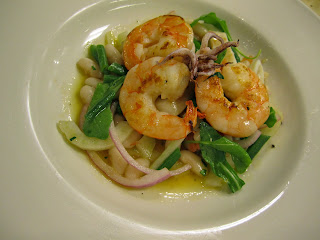
To engrain the importance of seasonality in cooking, our class made two dishes today that used ingredients currently available: pan-seared tuna with gazpacho vinaigrette and black olive couscous as well as charred shrimp and squid with white beans, citrus and herbs.

Speaking of seasons, the Cleveland Browns' regular season kicks off this weekend. Time to brainstorm Sunday game-time recipes and stock up on beer. (Too bad I'm not in town to buy brews from Great Lakes Brewing Co. I could totally go for a Burning River Pale Ale—or maybe one of the seasonal selections... )

Here we go Brownies, here we go! Woof! Woof!

Thursday, September 9, 2010

Veggie Tales

Day 34

Eat food. Not too much. Mostly plants.

That's sage advice from author and journalist Michael Pollan, passed down to my class by the chef currently teaching us about nutrition. Among his most famous works is "The Omnivore's Dilemma," which raises questions about why we eat the way we do. I'm sad to say the book is sitting on my shelf unread, but I plan to get to it as soon as I have time.

However, I recently rented "Food Inc.", a documentary that touches on both "The Omnivore's Dilemma" and Eric Schlosser's "Fast Food Nation" (another book on my to-read list). The movie is unsettling; it makes you take a deeper look at where and how your food is sourced. It should be required that every American watch this film.

We briefly discussed Pollan's research today during our second nutrition lecture, and I imagine we'll go into greater detail tomorrow when we cover sustainability. I wish it was something we covered more because people need to know what they're putting in their mouths so they can make better decisions.

Unsurprisingly, our recipes today were vegetarian: artichoke heart, fennel and watercress salad with grapefruit citronette and toasted walnuts; falafel; and roasted spaghetti squash with tomato caper sauce. Judging from everyone's empty plates after lunch, I think the meal was enjoyable.

I wish I was able to veg out and start Pollan's book tonight. Instead, I need to hit the books.