Thursday, April 28, 2011

My Big Fat Greek Easter

Forget the Cadbury Creme Eggs, Peeps and chocolate bunnies. Spring is all about lamb, phyllo, feta and more lamb.

Did I mention lamb?

This Sunday was Ryan and my 2nd annual Greek Easter celebration with our (obviously) Greek friend and his family. The party was at his house in Yonkers, N.Y., which got me pumped for two reasons: 1. I'd finally be able to see his outdoor brick oven in action and 2. His mom would be there with one of my favorite versions of spanakopita.
I'm slowly picking up on Greek Easter traditions—including learning my first Greek phrase, "Christos anesti," which means "Christ is risen." (The response is "Alithos anesti," or "He has risen indeed.") Every person who walks in the door is greeted this way.

There's also the tradition of tsougrisma, where each person receives a hardboiled, dyed egg and taps it against another's; the player with the uncracked egg continues. The last person remaining without a broken shell is declared winner and will have good luck the rest of the year. (For the record, I didn't win—this year or last.)
Not surprisingly, all the food was delicious. The roast lamb, artichokes and lemon potatoes were the centerpiece, surrounded by spanakopita, cheese pie (tiropita), moussaka, roasted chicken, two salads, Easter bread, Greek-style sliders, and on and on. I contributed non-Greek dishes, including a fresh ricotta and smashed pea spread with crostini (thanks to my good friend and fellow culinary grad, Amanda) as well as a shaved asparagus, aged gouda and hazelnut salad with lemon-honey vinaigrette.

Of course, a boatload of desserts followed the gut-busting dinner. I had to laugh when a tray of Greek cookies was accented with a few electric yellow Peeps and foil-wrapped eggs—a little bit of American tradition tossed into the mix.
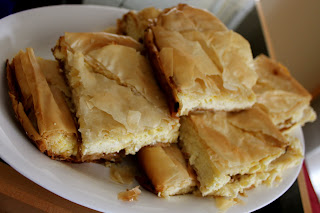
The feast was not unlike the holidays I grew up celebrating in that it was huge. Leftovers abounded, and every guest took home a 9 x 13 aluminum pan full of food. Ryan and I have been eating Greek all week. I even made a hearty ragu with the leftover lamb and artichokes, adding some diced tomatoes, onions, red wine and other herbs and spices, then topping it with a mound of ricotta cheese (thank you, chef Andrew Carmellini, for the inspiration).
A-tisket, a-tasket, next year I want lamb in my Easter basket.

Saturday, April 23, 2011

Going Green

For some, Friday, April 22, was Good Friday; for others, it was Passover. But for everyone around the world, despite religion, it was Earth Day.

In honor of the global holiday, I celebrated with a green meal. Yes, the food was primarily green in color (you should know by now how much I love double entendres), but I also thought about the environmental impacts of what I served.

First let me say that by no means am I a perfect example of sustainability. I try to be cognizant of what I'm putting in my stomach, whether it's at home or dining out. However, I know that everything I eat is not always local/humanely raised/fair trade/organic/etc. To be honest, it's quite difficult to live 100 percent this way (even yesterday's meal could be improved upon), but I try to do it as much as possible.

I chose a simple, spring dinner: Curry-dusted scallops over a pea puree with an arugula and spring onion salad.
Sustainable seafood has become a big topic of discussion, and thanks to the Monterey Bay Aquarium, people can be more conscious about what they're buying. Its Seafood Watch program allows people to scroll through a chart of seafood and make choices for healthy oceans. Whole Foods is using this program to guide consumers by placing labels on each item (the scallops I purchased there were listed as a "Good Alternative"—not the top "Best Choice" label, but I imagine better than most of what's out there.) You can also download the free phone app like I did.
There's also a big push for eating in season. Sadly, local peas haven't arrived at the Greenmarket (nor has any spring vegetable for that matter) so I bought frozen. (For more, read this piece by Michael Pollan on why frozen veggies are sometimes a good option.) I did, however, pick up a box of local arugula from one of my favorites, Satur Farms, located in nearby Long Island.

Curry-dusted Scallops with Pea Puree (Courtesy of Gourmet)
Yield: 4 servings

1 10-ounce package frozen peas (not thawed)
1/4 cup water
2 tablespoons unsalted butter
2 scallions, chopped (I used a 1/2 cup of spring onions)
1 to 2 tablespoons fresh lime juice
2 teaspoons curry powder
1/2 teaspoon pepper
1/2 teaspoon salt, plus more to taste
1 1/2 pounds sea scallops, muscle removed from side of each
1 tablespoon vegetable oil

1. Cook peas on stovetop in a small pot with 1/4 cup of water according to package directions; do not drain. Pulse in a food processor with cooking water, butter and scallions to make a course puree. Add lime juice and salt to taste.

2. Stir together curry powder and 1/2 teaspoon each salt and pepper. Pat scallops dry and coat all over with curry mixture.

3. Heat a large nonstick skillet over high heat; add oil. Saute scallops in two batches, turning once, until browned and just cooked through, about 4 minutes per batch. Serve scallops over the pea puree.

The meal was not only simple and satisfying, it made me feel like I was contributing a bit to the planet's well being. Time to make this an Earth Year.

Tuesday, April 19, 2011

All Thai'd Up

After a recent work-related event, I found myself carrying home a 14-ounce can of coconut milk, a bottle of fish sauce, a jar of red curry paste and dried lemongrass. What's a girl to do but the obvious, i.e., whip up a Thai-inspired dinner?

When I phoned Ryan and told him we were having coconut curry tilapia, it was like he'd won a prize. (I should have expected this: I'm pretty sure I noticed him staring longingly at the Madras curry powder I bought a month ago and hadn't opened.) Do people know that curry might just be a way to a man's heart? Perhaps I should alert the masses.

There was barely a trace of the sauce, which was supposed to be for four, remaining in the pan less than a half-hour later.
Coconut Curry Tilapia (adapted from Cooking Light)
Yield: 4 servings

1 teaspoon sesame oil, divided
1 teaspoon vegetable oil
2 teaspoons fresh ginger, minced
2 garlic cloves, minced
1/2 stalk of dried lemongrass (soften it in a bit of warm water before using—or just use fresh)
1 red bell pepper, thinly sliced
1 small yellow onion, thinly sliced
2 teaspoons curry powder (I used Madras)
2 teaspoons red curry paste
2 teaspoons low-sodium soy sauce
1 teaspoon fish sauce
1 tablespoon brown sugar
1 can (14 ounces) coconut milk
Salt, to taste
2 tablespoons fresh cilantro, chopped
4 tilapia fillets, approximately 6 to 8 ounces each
1 lime, cut in wedges

1. Preheat oven to 450 degrees.

2. Heat 1/2 teaspoon of sesame oil and 1 teaspoon of vegetable oil in a large nonstick skillet over medium-high heat. Add ginger, garlic and lemongrass and cook 1 minute. Add peppers and onions and cook 2-3 minutes. Stir in curry powder and curry paste; cook another minute. Add soy sauce, fish sauce, brown sugar and coconut milk and bring to a simmer (do not boil). Simmer for about 5 minutes, then remove from heat, season with salt and stir in cilantro.

3. Meanwhile, brush fish with remaining sesame oil and season with salt. Place fillets on a baking sheet coated with cooking spray (or line with parchment paper). Bake 7 minutes or until fish flakes easily when tested with a fork.

4. Serve fish with sauce, lime wedges and basmati or jasmine rice.

Someone just might want to Thai the knot with you after this one.